

TRANSACTION INFRASTRUCTURE
Transaction infrastructure for humans and AI
The platform your lawyers run deals on is now the platform your AI works in.
THE PROBLEM
Your AI can't see the deal
Document-level AI is impressive on contracts and invisible on transactions.
Your firm’s AI tools can read a contract. They can’t see the transaction it belongs to: the conditions it satisfies, the parties who need to sign it or the deadline it sits against.
- AI output lands in inboxes, disconnected from the deal
- No deal context means answers reconstructed from prose, not data
- No permissions or audit trail means risk committees say no
- Pilots impress everyone and change nothing about how deals run
THE SOLUTION
One platform for your people and your AI
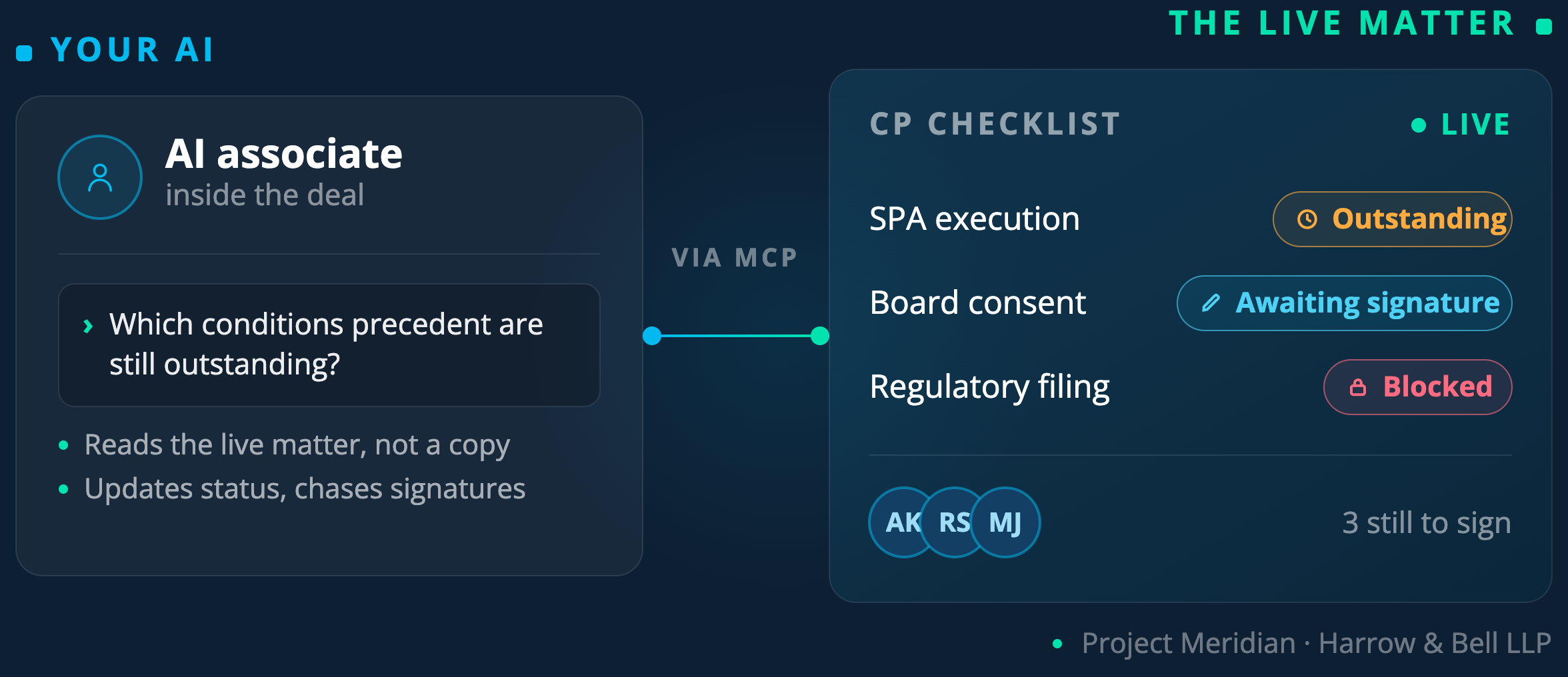
Legatics holds the live structure of every deal, and AI tools connect to it through MCP.
Lawyers already run transactions on Legatics: checklists, signing, binders and data rooms in one place. Now any MCP-capable AI tool (Harvey, Legora, Claude, your own agents) can read and act on live matters under the same permissions and audit trail.
For AI, that means two things: the context of the live deal, and a place inside it for work to land.
WHY IT MATTERS
Built for AI that has to earn a risk committee's trust
Context your AI can query
“What's outstanding on the CP list and who's holding it up?” becomes a query with a precise answer, not guesswork over documents.
Governance built in
Every AI action is permissioned and logged, defined the same way a person's access is. That's what gets AI use past a risk committee.
One connection, every tool
MCP is an open standard. Connect once and every current and future AI tool becomes transaction-aware. No bespoke integration per vendor.
No vendor lock-in
Legatics doesn't compete with your AI tools. Swap vendors, run multiple models or bring your own agents without rebuilding anything.
Somewhere for output to land
Agent work updates the matter as part of the deal record, not another attachment for an associate to manage.
Proven for humans first
Nothing was bolted on for the AI story. The same structure that runs deals for lawyers today is what makes the platform usable by AI.
THE WORKFLOW
How it works
01
Run the deal in Legatics
Matters, Lists, Signing, Binders and Data Rooms hold the live structure of every transaction.
02
Connect your AI through MCP
Any MCP-capable tool reads and acts on live matters: querying status, updating items, flagging blockers.
03
Supervise everything
Permissions define what each agent can see and do; the audit trail records what it did.

WHY LEGATICS
The layer that works whichever AI wins
AI vendors will change. The transaction layer they work in won’t. Legatics is the only platform in the category with structured transaction data, established firm trust and live AI connectivity today.
- Structured deal data: tasks, conditions, parties, documents and deadlines, all related
- Years of workflow logic: built by lawyers, encoding how transactions really run
- Trusted at scale: ISO 27001 certified, live on firms' most significant matters
- Live MCP server: in production now
- Delivery data: metrics on how deals get done, by humans or AI
COMMON QUESTIONS
Frequently asked questions
Good. Legatics is what makes them work on transactions. They read documents brilliantly, and connected to Legatics they can also see the deal: what’s outstanding, who’s responsible, what’s blocking closing.
Read and act on live matters through our production MCP server: query task status, update checklist items, flag conditions and surface blockers, all within permissions you define.
Integrations pass a document between two tools. Infrastructure is the layer a whole workflow runs on, where AI can see and act on the entire transaction.
The same way human access is: role-based permissions at matter, list and document level, with every action logged and attributable.
The opposite. MCP is an open standard, so any capable tool connects the same way. That’s independence, and negotiating leverage.
Both, deliberately. We build AI into the platform where it helps specific workflows, and the same infrastructure connects whatever AI tools your firm has chosen. Our workflow AI and the open connection layer are the same infrastructure, used two ways.
GET STARTED
Make your transaction layer AI-ready
Your firm is choosing its AI stack now. See what your AI tools can do when they can see the deal.