

Every managing partner has sat through a version of this meeting. The firm has committed serious budget to AI. The board wants to know the return. The partnership wants to know the plan. Competitors are making announcements. And every option on the table looks like the same uncomfortable thing: a bet on a specific vendor in a market that changes monthly.
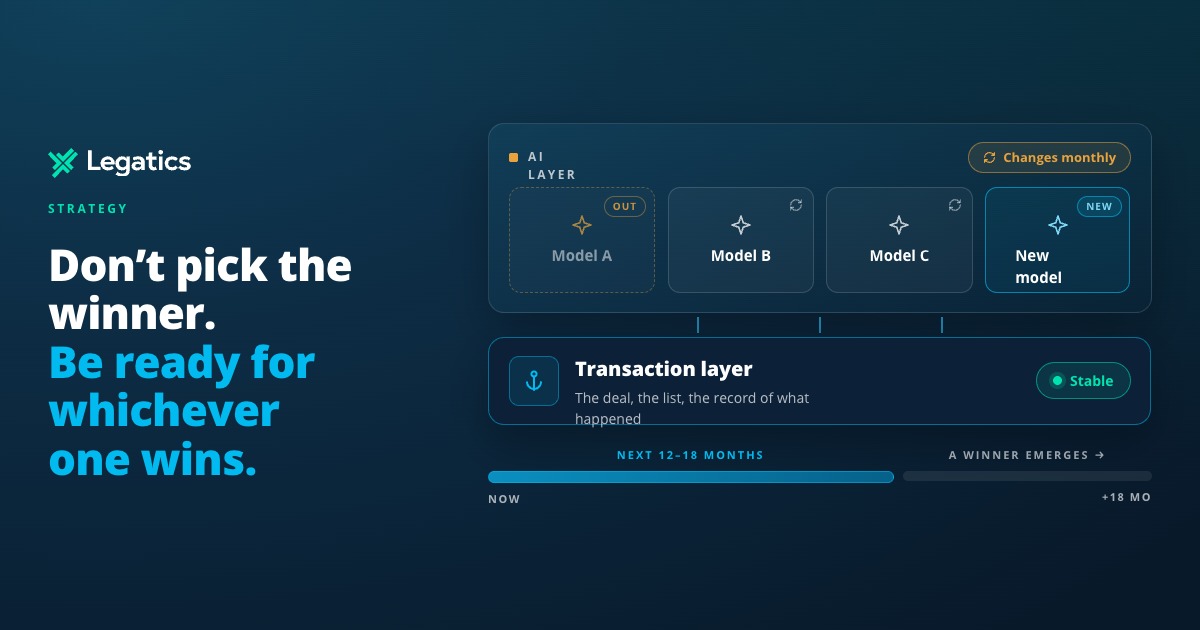
There’s a reframe that turns the impossible bet into a workable strategy: you don’t have to pick the winning AI. You have to make sure your transaction layer is ready for whichever one wins.
The bet nobody can price
Betting on an AI vendor requires believing several things at once: that the model stack they rely on (whether third‑party or in‑house) stays ahead of rivals shipping monthly, that their pricing survives its own economics, that their roadmap tracks your practice mix and that they’ll still be the right answer in three years.
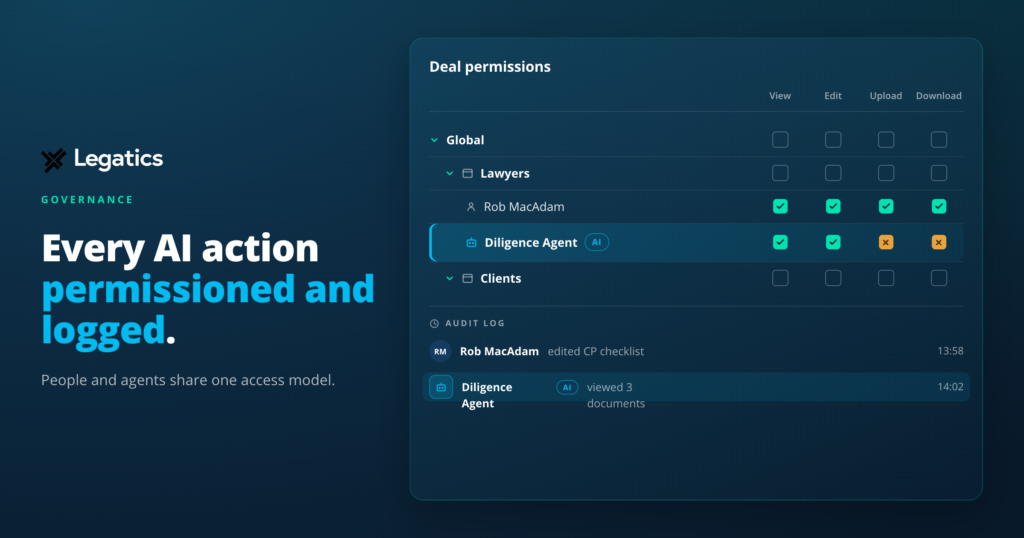
Set that against what doesn’t change. Transactions will still run on conditions, signatures, parties, documents and deadlines. Firms will still need governance over who (and what) can see and act on client matters. Whatever AI wins, it will need structured deal context to do transaction work, and somewhere for that work to land.
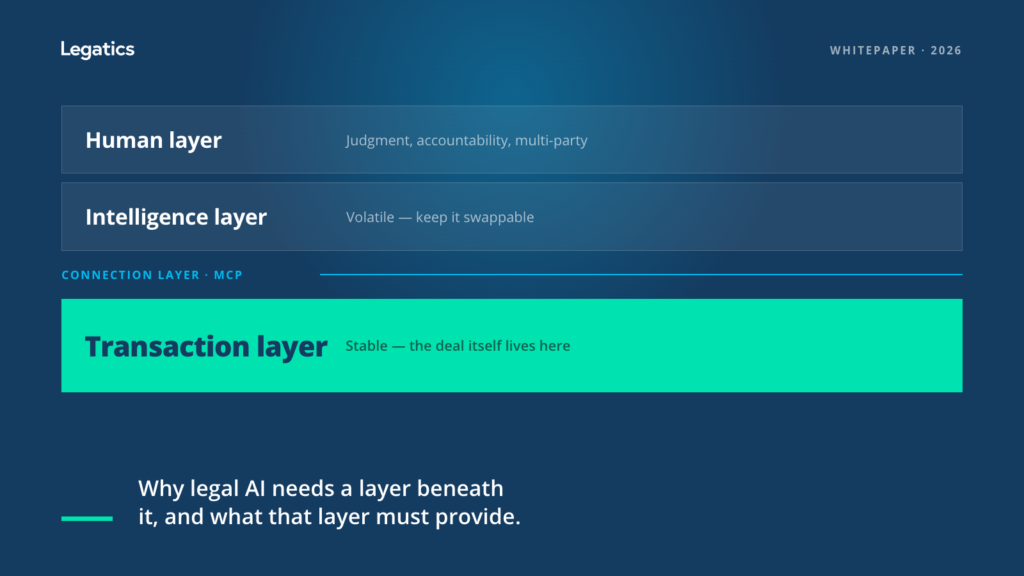
The AI layer is volatile; the transaction layer is stable. Durable strategy invests in the stable layer and keeps the volatile one swappable.
What “getting the infrastructure right” means
Infrastructure is a deliberate word. Tools get used; infrastructure gets built on. It has three properties that matter for an AI strategy:
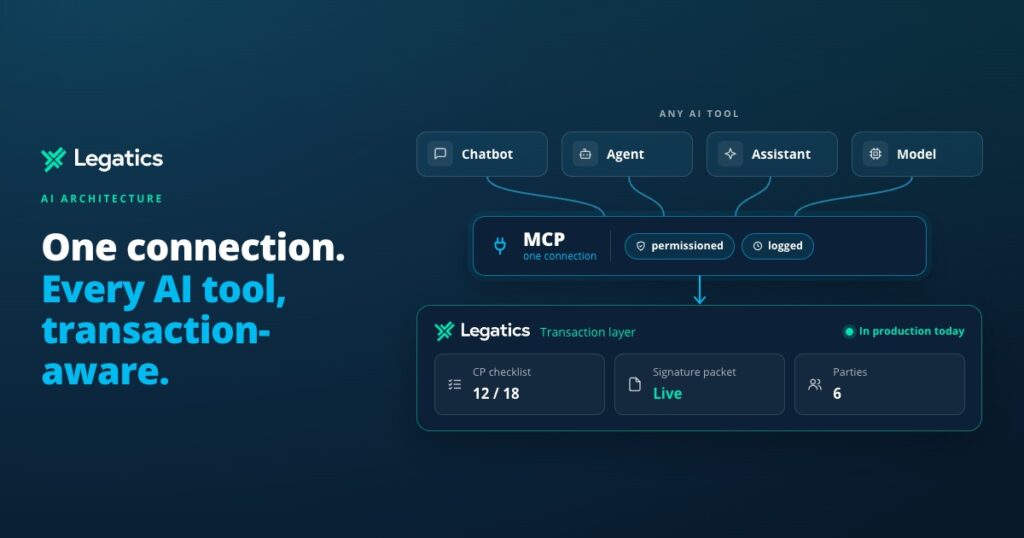
- It’s neutral. The transaction layer doesn’t compete with the AI tools that run on it, which is exactly why firms can connect any of them without conflict. Legatics doesn’t ask you to bet on Harvey, Legora, Claude or your own agents; any MCP-capable tool plugs in.
- It persists. AI workflows built on the transaction layer survive vendor changes above it. The switching cost sits with the replaceable tools, not the layer.
- It compounds. Every matter run through structured infrastructure deepens the transaction data that makes every future AI more useful. The asset grows as AI capability grows.
It also converts AI from an unmeasurable experiment into something observable. AI activity inside a transaction platform is visible, auditable and attributable to real matters, and because the deals themselves run through the platform, the firm gets delivery metrics: how its matters actually get done, by humans or AI, and where the AI is helping. “What’s the return on our AI spend?” becomes a question with data behind it. That’s a strategy you can present to a partnership.
Why the window is now
If the infrastructure logic holds regardless of timing, why the urgency? Because firms are making their AI infrastructure decisions now and stacks, once assembled, harden.
Three things are converging. First, AI adoption is outrunning the question of where the output goes; most firms buying document-level AI haven’t answered it, and the gap is being felt on live deals today. Second, MCP has given the market an open standard to converge on, so the connection between AI and workflow is no longer speculative; on Legatics it’s in production, with AI tools reading and acting on live matters. Third, the category is being shaped as we speak: “transaction infrastructure” is emerging as the category that connects AI to real transaction workflow.
The firms that define their transaction layer in the next 12–18 months will shape how their deals run, and how their AI works, for the decade after. Firms that wait on both the AI choice and the infrastructure choice will be starting from scratch while their competitors’ AI is already working inside live matters.
The strategy you can stand behind
Put the pieces of this series together and the leadership answer to “what’s our AI position?” looks like this:
Our deals run on a structured transaction platform our lawyers already use. Our AI tools, whichever we choose and however they change, connect to it through an open standard, governed by the same permissions and audit trail as our people. We measure AI by what it does on real matters. And we’ve made the one investment that gets more valuable whichever way the AI market moves.
Conclusion
The most consequential AI decision your firm makes this year probably won’t have “AI” in the contract title. It will be the decision about where your transactions, and everything that works on them, actually run.
If you’re shaping your firm’s AI strategy, we’d welcome the conversation. Book a demo and see what an AI-ready transaction layer looks like on a live matter.