

Anyone comparing legal AI vendors runs into an uncomfortable fact early: the models are converging. The gap between the leading systems narrows with every release, and capability that was a differentiator six months ago is table stakes today. If your evaluation is built around “which model is smartest,” you’re measuring the thing that changes fastest and matters least.
What actually determines the value of AI on a transaction is something the model doesn’t bring with it: context. And context is the part of the equation firms control.
The same model, two very different answers
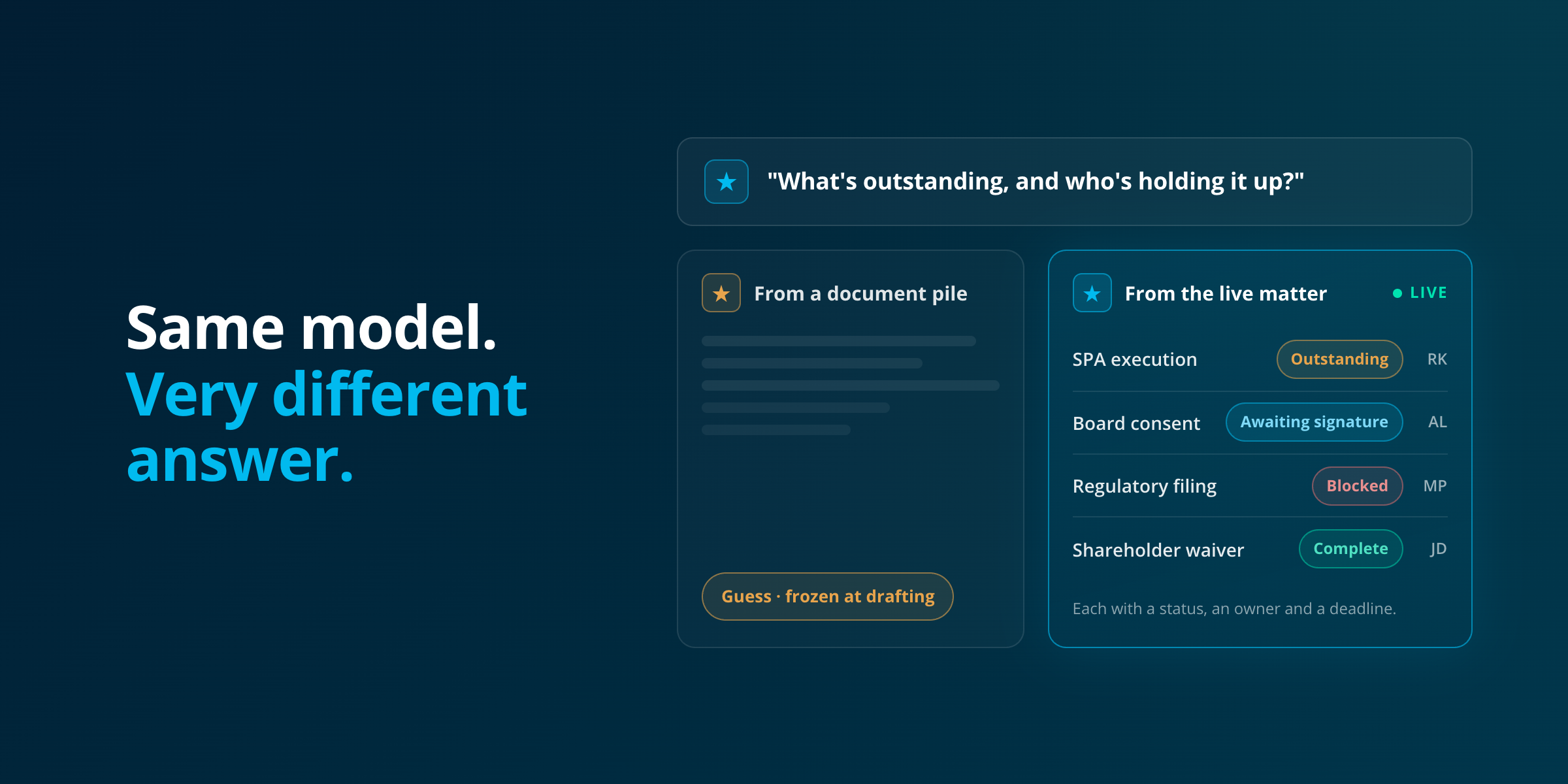
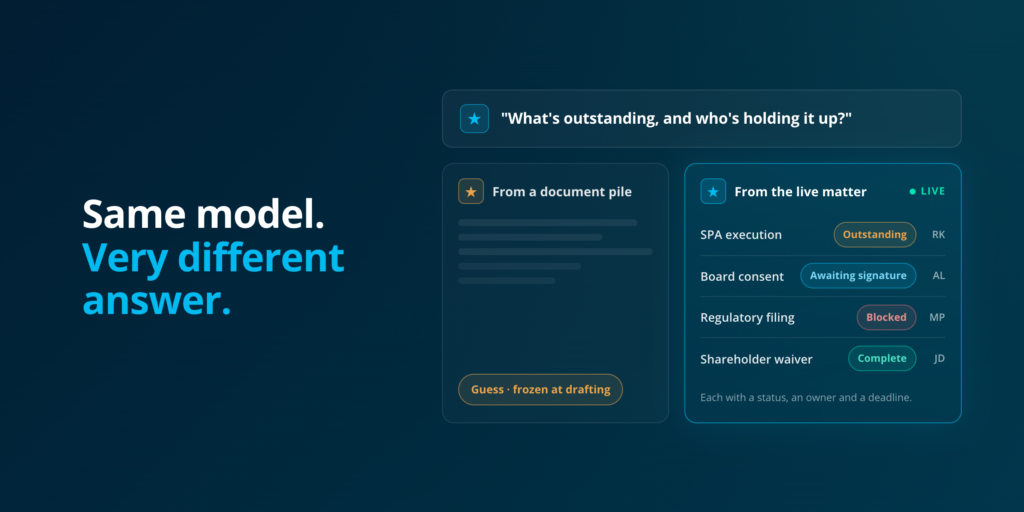
Imagine asking an AI tool a question every deal team asks daily: “What conditions are outstanding and who is holding them up?”
Without deal context, the AI has a pile of documents. It can find the facility agreement, locate the CP schedule and reconstruct a list from prose. It doesn’t know which conditions have been satisfied since the document was drafted, who took ownership of each item or what was agreed on last week’s call. Its answer is an educated guess about a deal frozen at drafting time.
With deal context, the same model queries a live CP list: every condition with a current status, an owner and a deadline, connected to the documents that satisfy it. The answer is precise, current and attributable. The model is the same one that guessed a moment ago; what changed is what it could reach.
Practice-area depth doesn’t come from the model; it comes from structured deal data the model can query.
Documents are not deals
The distinction that matters here is between a document library and a transaction model.
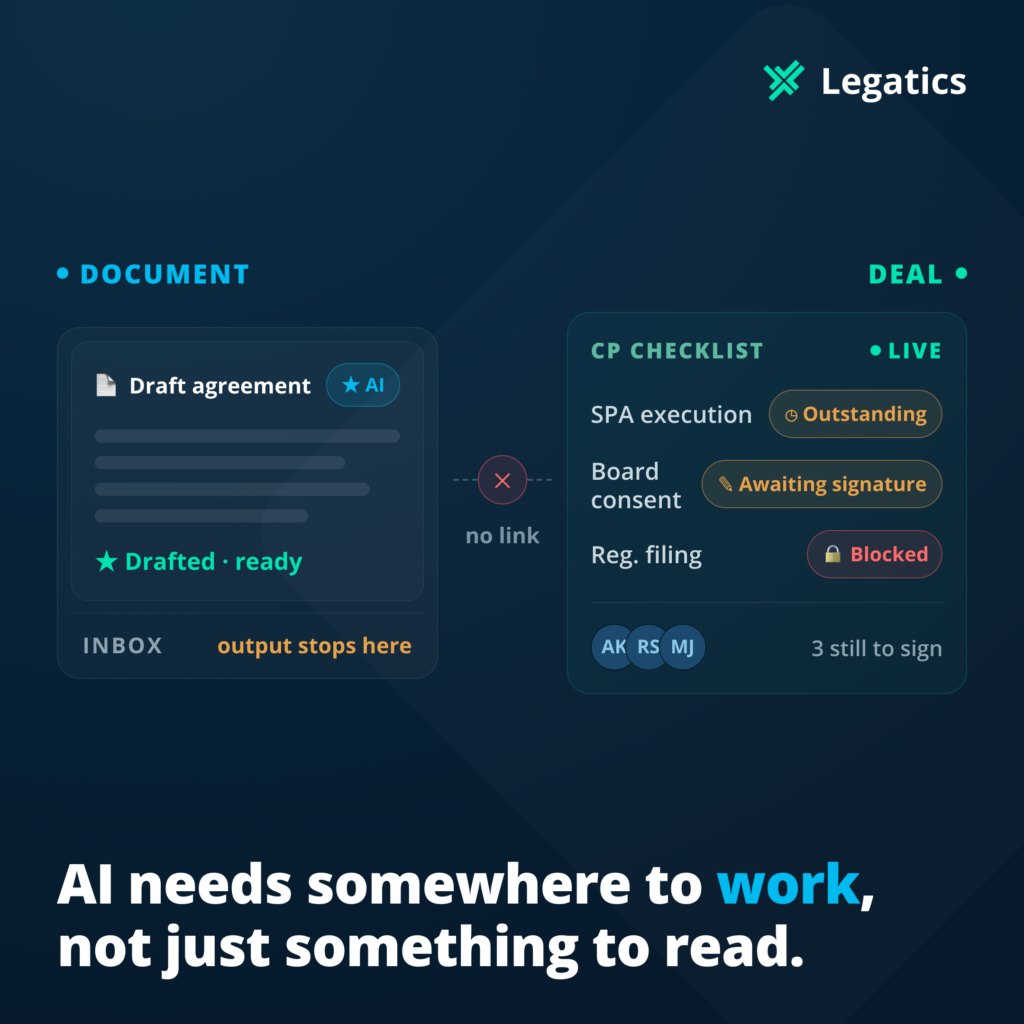
A document library, however well organized, stores files. Everything a deal team knows that isn’t in a file (statuses, responsibilities, dependencies, what’s blocking closing) lives somewhere else: in email threads, in spreadsheets, in people’s heads. AI pointed at a library inherits that blindness.
A transaction model stores the deal: tasks, conditions, parties, documents, signatures and deadlines, related to each other. The CP list your associates maintain becomes queryable data. Signing status becomes structured state. A document isn’t a file in a folder; it’s an item with a known role in a known transaction.
This is what we mean when we describe Legatics as transaction infrastructure. The platform holds a live, structured model of each deal, built up naturally as lawyers run their matters. Nothing was bolted on for AI; the same structure that replaced stale Word checklists for humans is what makes the deal legible to machines.
Why this took years, and why that matters
Structured transaction data doesn’t appear when you sign an AI contract. It comes from workflow logic: knowing how conditions precedent actually behave on a financing, how signing coordination really works across time zones, what a closing set needs to contain. That logic took years of lawyer-led development to encode, and it’s refined every time a firm runs a matter.
Keep that in mind when evaluating AI-first vendors who promise transaction awareness. Models and interfaces they have. The transaction workflow structure, firm-wide adoption as a system of record and the trust to hold live deal data: those take years, and they’re the parts that make context possible.
The strategic consequence
If models converge and context differentiates, the investment logic for law firms inverts:
- Model choice becomes low-stakes. Whichever tool you pick will improve, and you can switch. Betting heavily on one vendor’s model is betting on the fastest-depreciating asset in the stack.
- The context layer becomes the durable asset. Every matter run through structured infrastructure deepens the data that makes any AI more useful. That asset compounds while models churn.
- Openness matters more than features. A context layer that speaks an open standard (MCP) serves every model, current and future. One that’s proprietary to a single AI vendor is a lock-in mechanism.
Firms that get the context layer right once are insulated from churn in the AI layer above it. That’s a strategy that survives the next model release, and the fifty after that.
Conclusion
The next time an AI evaluation lands on your desk, add one question to the scorecard: what context can this tool actually reach on our live transactions? The answer will tell you more about the value you’ll see than any benchmark.
In the next post we’ll look at governance: why “every AI action permissioned and logged” is the sentence that gets AI programs past risk committees.
Curious what your AI tools could do with live deal context? Book a demo and see a matter through the AI’s eyes.