

In practice, whatever the deal size, you’re never short of checklists. You’ve got the conditions precedent list, the disclosure checklist, the signing and closing checklist, the post-completion list etc. These are often all maintained by different people, some in Word, some in Excel, some buried in email chains. The problem was never generating a list. The problem was managing it, getting everyone aligned, and keeping it accurate.
So I was delighted to hear Max Junestrand declare at Legora’s Precedent event that they have “List fever.” Welcome to the club guys!
We’ve spent ten years helping lawyers manage complex transactions in Lists, and I’ve worked on legal lists in a few contexts before that: iSheets at HighQ, corporate legal lists for contract, spend and matter management with Elevate and BusyLamp and now transaction management lists at Legatics. So hopefully I’ve earned a view on what makes this space interesting, and what makes it quite hard.
That distinction, between list creation and list management, is exactly what I was thinking about when I saw Legora’s new functionality.
AI-generated checklists are genuinely useful. But creating a clean, logical plan has always been the easy part; ask any legal project manager! The hard part is what happens next. Once a deal has 10 parties and stakeholders, eight key workstreams, split exchange and completion, lawyers across three time zones, and a signing deadline that keeps moving, the coordination challenge becomes something a simple list can’t solve. You need the right transaction infrastructure to properly manage the deal, and that sits at the heart of what we do at Legatics.
Legora’s approach (lists as a destination for AI output and connective tissue for agents) is the logical direction for them to go in. But there’s a significant gap between simple AI lists and lightweight tracking and what’s really required to manage complex transactions. When I was trying to understand the extent of Legora’s new list functionality, it crystallised just how much is actually required.
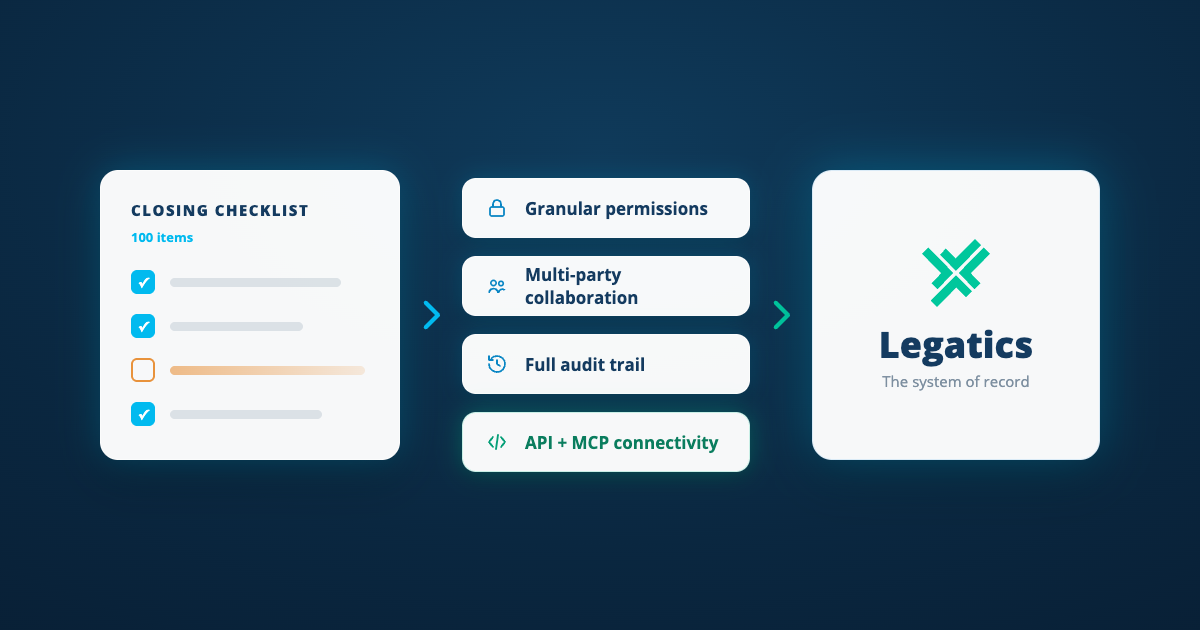
Take a 100-item closing checklist across multiple workstreams, shared with the client, counterparty firms, two banks, PE house, and a CF advisor, all with different visibility, different permissions, and a signing workflow at the end. That requires a lot more than rows and columns:
- Matter management: the list needs to live within the deal, not exist in isolation. Context really matters, e.g., status, parties, documents, and deadlines are all interconnected, and a list that doesn’t know which deal it’s on is not as effective.
- Complex list management: sections, multiple documents per row, versioned attachments, automated workflows, in-column DMS integrations. Complex deals have complex structures; flat rows and columns don’t accommodate that without the whole thing falling apart.
- Granular permissions: what a firm sees is different from what the client sees, which is different from what the other side sees. Scoping visibility and editing rights across every party on a deal is essential and it’s how you maintain control of a live transaction.
- Multi-party collaboration: all parties need to work from the same version of the truth, in real time. The moment you’re sharing lists by email or maintaining parallel copies, the coordination has already broken down.
- Integration with transactional workflows: lists are only one part of the deal, but they need to connect to data rooms, signing, binders etc. An isolated list puts the coordination burden back on the lawyers, which is exactly the problem it was supposed to solve.
- Governance and audit: who updated that status, when was that document approved, who had visibility at signing, was it human or AI. These questions come up constantly, and the audit trail has to span every party across the full lifecycle. Internal-only logs aren’t enough when the deal involves many participants.
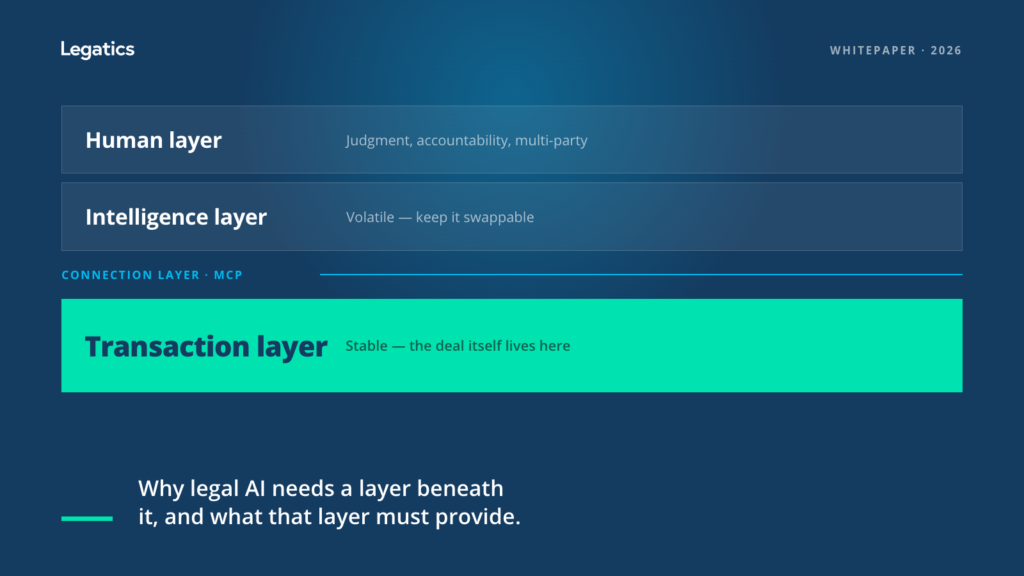
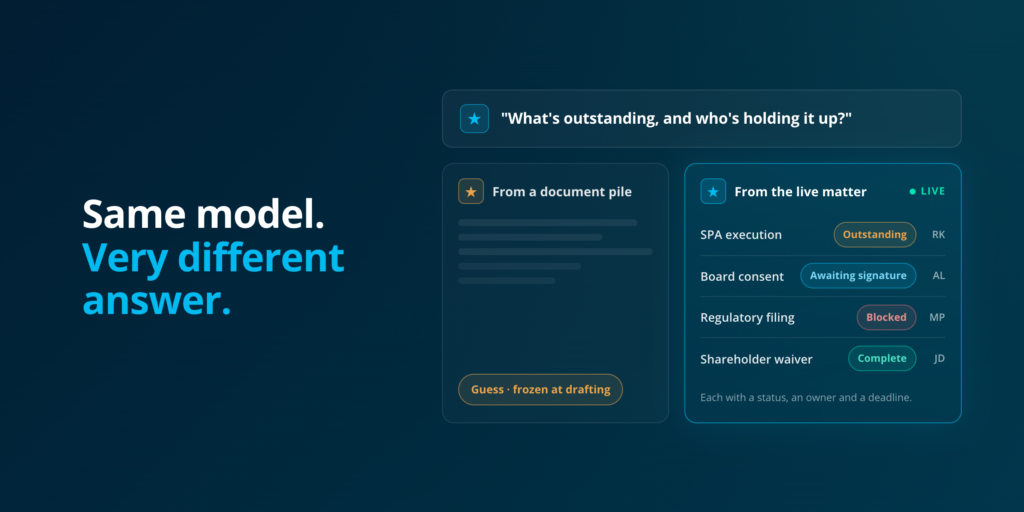
- AI ecosystem connectivity: AI output needs somewhere authoritative to land, where everything is tracked, actioned, and auditable. A platform with MCP and API connectivity becomes the system of record and workflow that AI plugs into, not the other way around.
Without these, you have a simple list. But with them, you have genuine transaction management.
There’s no doubt agents will increasingly help with the management side by monitoring deal status, flagging risks, chasing actions. But nobody is setting agents loose on a multi-million dollar cross-border acquisition unsupervised; not for a while anyway. The coordination still gets done by humans, and humans need the right tools to do it at the right scale and complexity.
Transaction management is also not limited to Lists. A deal’s data lives across multiple touch points such as the data room, the due diligence tracker, the signing workflow, the closing binder. Lists are the coordinating spine, but the spine only works as part of the full body. This is also why “list” is sometimes too small a word for what we’re actually describing. A list is a layout for data; what we’re building at Legatics are transactional data models: structured, permissioned, connected representations of everything that needs to happen, by whom, and in what order, before and after a deal.
AI-first vendors are realising that their defensibility depends on becoming the system where work gets done. Lists was always going to need to be part of the equation, but it’s not a fast problem to solve. We’re already solving the list challenge at scale, evidenced by tens of thousands of matters, hundreds of thousands of list rows and hundreds of external parties collaborating on Legatics across some of the world’s largest law firms.
We’re already the transaction infrastructure and orchestration layer. What AI tool you use is largely irrelevant. But you always need a system where the transaction gets done, with tools that match the complexity of the deal.
So, to our new friends with List fever: welcome. Lists matter. The question is what they can do when they’re built for the full complexity of the deal.
When I was in practice, I was never short of checklists. What I lacked were tools that could manage the actual complexity of a deal and keep all the stakeholders aligned.
That’s what Legatics does.