

Law firms spend millions on legal technology. Matter management. Document management. Signing tools. Transaction trackers. And then, for one of the most frequent tasks in transactional practice, secure document sharing, they reach for an expensive, over-engineered platform that was built for something else entirely.
Most firms know this arrangement is imperfect. Few have done anything about it.
The hidden cost of complexity
Enterprise collaboration platforms are powerful. For complex, bespoke client portals and large-scale projects, that power is justified. But the same platform handling your most complex client relationships is also being spun up for a routine mid-market acquisition. Or a straightforward real estate disposal. Or a refinancing where the counterparty just needs a secure place to review documents.
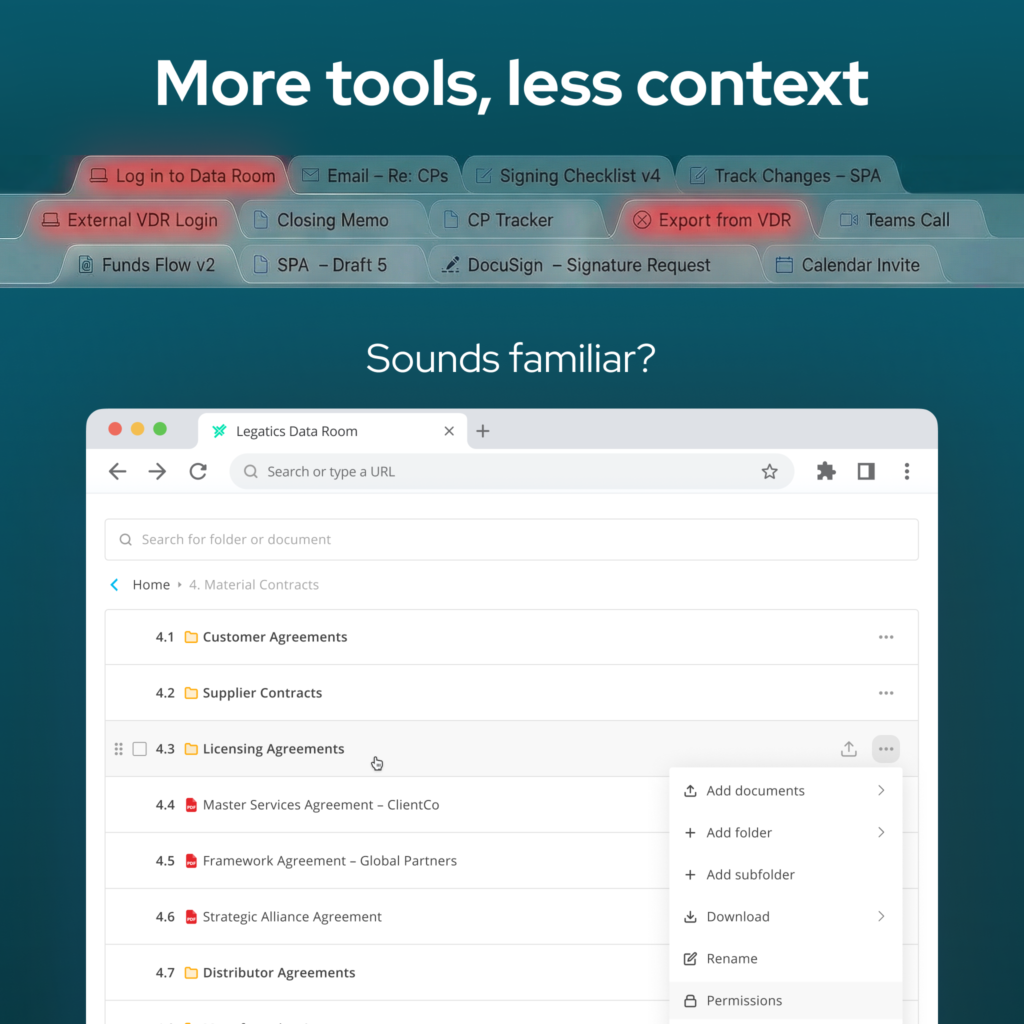
The functionality required for everyday transactions is a fraction of what these platforms offer. Yet the cost is the same. And the setup, the training overhead, the dependency on IT or innovation teams to get rooms up and running, adds friction to deals that are already time-sensitive.
The result is a quiet irony: firms have invested heavily in making transactions faster and more efficient, but when it comes to secure document sharing, they are still operating with tools calibrated for their most demanding 10% of work.
What lawyers actually need
Strip back the noise and the core requirement is straightforward. Lawyers need a secure, controlled space to share confidential deal documents with clients, counterparties, and advisors. They need permissions they can set themselves. They need version control and an audit trail. They need it to connect to their document management system without manual workarounds. And they need to be able to set it up in minutes, not hours, without raising a support ticket.
That is not a complex product requirement. It is a basic operational need that has been consistently over-served by the market.
The case for stripping back
The data room market has drifted toward feature accumulation. Each platform generation adds capability: richer analytics, more granular access controls, AI-assisted review, dynamic watermarking. For the transactions that demand it, that depth has value.
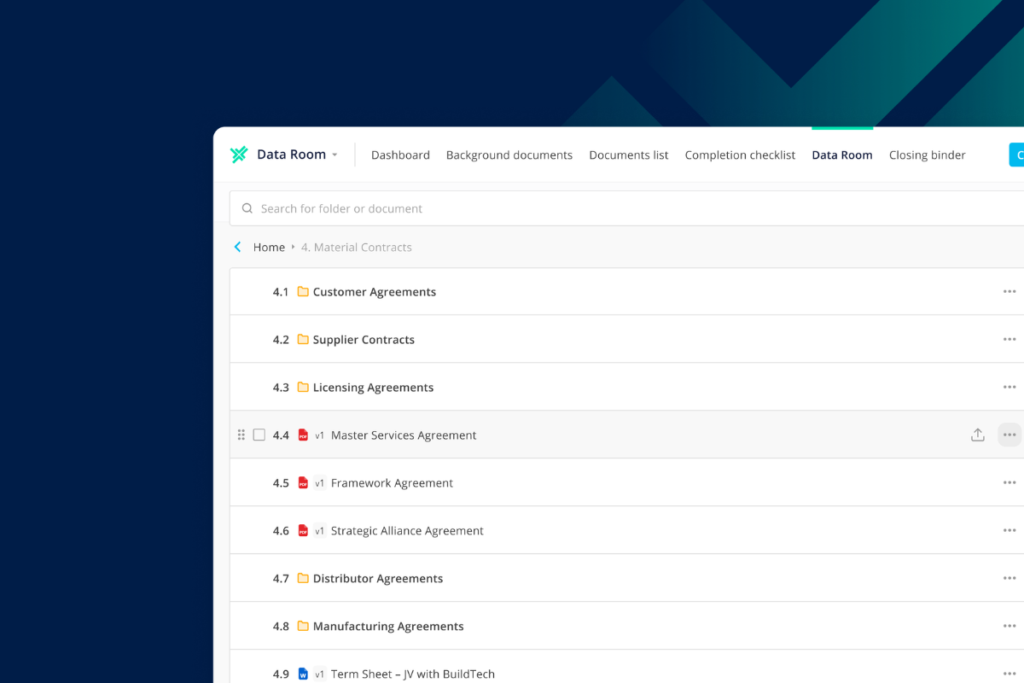
But the majority of transactions do not demand it. They need a clean folder structure, sensible permissions, reliable version control, and a full audit trail. They need lawyers to be able to create and manage the room themselves, without training and without a support request. They need it to work the first time, on a tight deadline, with a counterparty waiting.
Complexity is not a feature. For most deals, it is a cost with no corresponding benefit.
A different way to think about it
The right question is not how to make your current data room tool work better. It is whether the tool is appropriately matched to the work it is being used for.
A platform built for everyday transactions looks different from one built for the most complex mandates. It has the essential functionality — permissions, version control, audit trails, DMS integration — without the overhead that slows teams down when speed matters more than feature depth. And when that platform also handles checklists, signing, and completion, the deal team works from a single environment rather than moving between systems for every update.
For some transactions, a full-featured enterprise platform is the right answer. For the hundreds of routine matters a firm runs every year, a simpler, faster, lower-cost approach is not a compromise. It is the better choice.