

Closing a legal transaction is one of the most coordination-intensive moments in any deal. In the hours before completion, conditions need to be confirmed as satisfied, documents need to be executed by multiple parties across multiple firms and a complete closing record needs to be assembled and delivered to the client.
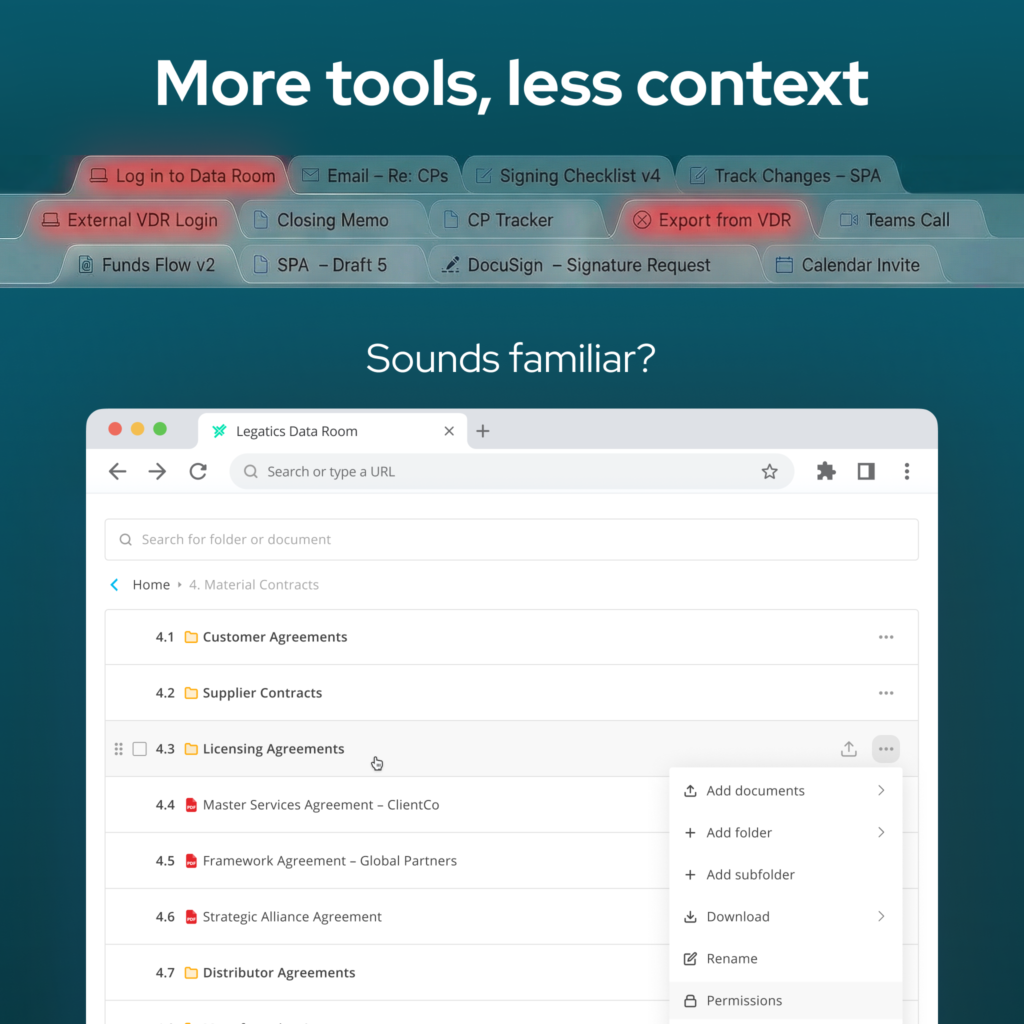
For most firms, that process still runs on MS Word tables, spreadsheets and email. It’s slow, it creates version control problems and the deal lawyer ends up spending significant time routing information rather than progressing the deal.
Digital transaction closing replaces that with a single, shared environment. Here’s what each stage looks like:
Conditions precedent
A live completion agenda replaces the circulated spreadsheet. Every CP has an owner, a status and a satisfaction record, updated in real time and visible to every party simultaneously. When something is satisfied, everyone sees it. When something is at risk, it’s flagged — not buried in an inbox.
Signing
Signature pages are distributed, tracked and assembled in the platform. Signing status is visible to the whole deal team across all documents and parties, with support for both electronic and wet ink execution. Final executed documents are assembled automatically as pages are returned.
Client visibility
Clients and counterparties access a live view of deal progress directly, without requiring the deal lawyer to compile a manual update. The partner’s role shifts from information compiler to deal progressor.
Closing binder
Because every document has been tracked throughout the transaction, the closing binder is generated automatically at the end — organized, indexed and ready to deliver. No overnight assembly job.
How Legatics handles this
Legatics manages the full closing workflow in one environment: live completion agenda, signing coordination, client access and automatic closing binder generation. Used by transactional teams at leading global firms across M&A, banking and finance, real estate, capital markets and project finance.
Closing a transaction digitally doesn’t mean eliminating legal judgment. It means eliminating the administrative overhead that surrounds it.