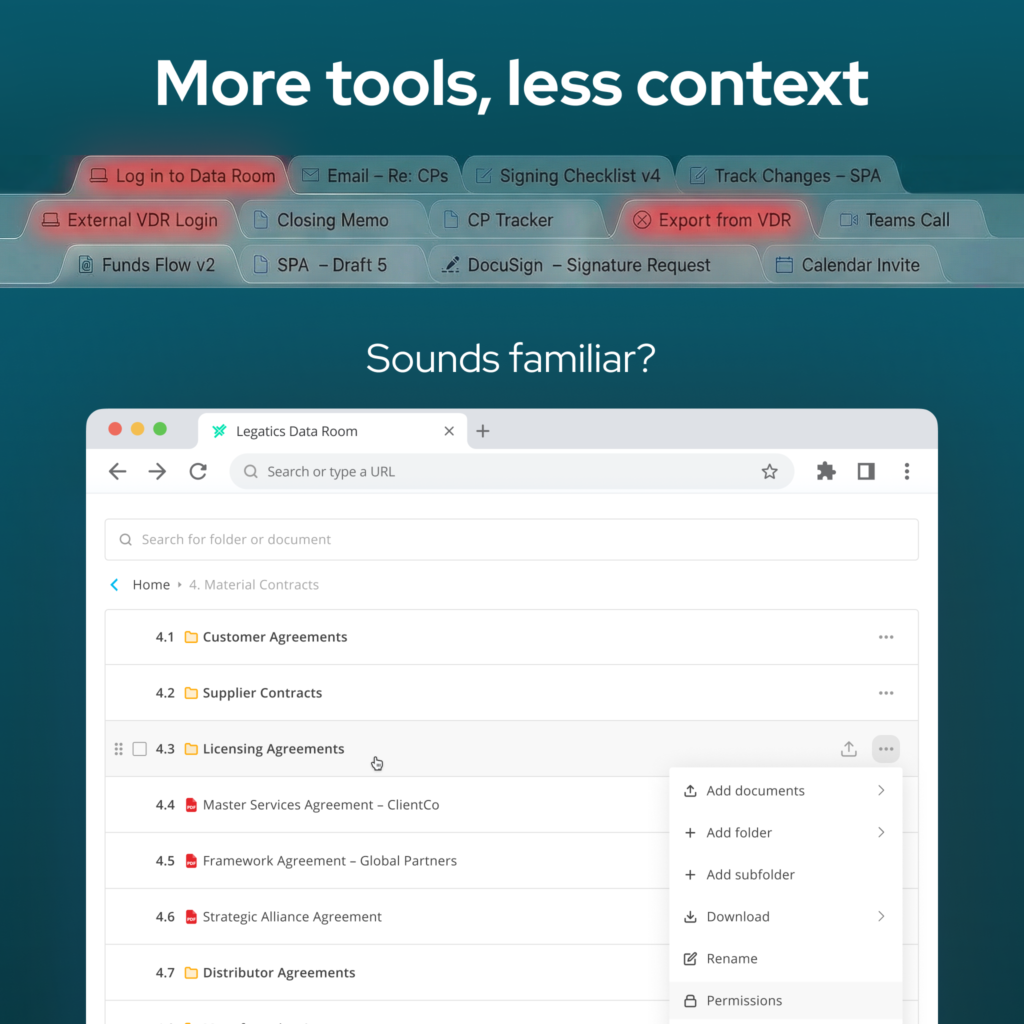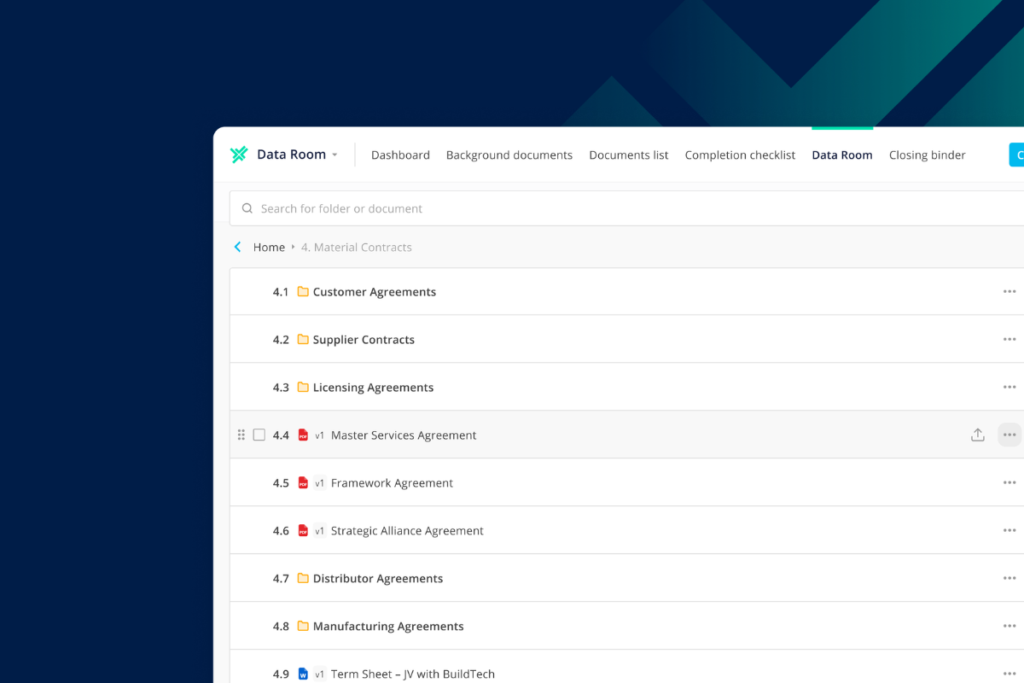


Your firm uses MS Word tables, Excel spreadsheets and email to manage transactions. So does everyone else. But somewhere between your first deal and now, this manual approach stopped being a solution and became the problem. Here are five signs you’ve outgrown the traditional transaction management process and need a new approach.
Sign 1: You spend more time managing versions than managing deals
Monday 3pm: Associate downloads the CP tracker from Friday, updates five items. Monday 4pm: Partner from another law firm on the deal downloads their version of the same tracker to review before Tuesday’s client call and makes notes. Monday 5pm: Paralegal from a third firm downloads the version they received to mark three documents as received.
Tuesday morning: Multiple law firms working on the deal discover they’re each working from different versions of the documents list. The real challenge isn’t just internal version conflicts—it’s that multiple law firms are producing and circulating their own updates to the CP tracker asynchronously. Which version accurately reflects the latest documents or status across all parties? By the time everyone’s updates are circulated, updated, returned and reconciled, the information is already stale.
At large US law firms, associate billing rates often exceed $1,000 per hour. Even modest amounts of time spent reconciling version confusion can therefore translate into $75,000–$100,000 per firm per year in pure administrative cost. [1]
What forward-thinking firms do
Real time collaborative platforms where all parties—across all law firms on a deal—work in the same list simultaneously. When everyone updates status in one place, version and status conflicts become impossible. Partners and associates across firms can check status and know it’s current.
Sign 2: Finding information requires email archaeology
A client asks about the escrow provision discussed “a few days ago.” You remember the discussion but not the specific resolution—was it 10% or 15%? Standard or modified terms?
You search your email for “escrow”: 63 results across 8 threads. Twenty minutes hunting through messages to find the exact language you agreed to.
Another associate needs the latest draft of the Share Purchase Agreement to review a specific clause. Was it the version emailed Tuesday morning? Or the one attached to the Thursday afternoon thread? Or did someone send an updated version Friday? Download three different attachments, check timestamps, compare file names like ‘SPA_v3_final.docx’ and ‘SPA_v3_FINAL_clean.docx.’ Ten minutes gone trying to figure out which is actually the latest version.
When associates leave, their email knowledge doesn’t necessarily disappear—but accessing it requires IT requests to open their inbox, then hunting through months of messages trying to find relevant information.
What forward-thinking firms do
Transaction platforms break down silos by capturing information where work happens. Comments thread directly on relevant items. Knowledge stays with the deal, accessible to the team, not trapped in individual inboxes.
Sign 3: Status updates take longer to compile than to present
A client needs a status update for their Monday call. Since the documents list is managed manually across multiple parties, no one knows if the data is current—which means extensive verification before anyone can trust it. Three associates and a trainee each spend 45 minutes checking email threads, notes and the DMS to confirm what’s actually happened versus what the tracker shows. Only after all this verification can they update the documents list with confidence.
The Partner spends another hour reviewing where things stand and crafting an email summary for the client. Total team time: 3+ hours. By Monday, the information is already outdated.
Annual time investment for monthly updates across 20 active matters: 960 hours. This amounts to $900,000+ at typical Big Law rates.[^2]
What forward-thinking firms do
Real time dashboards show current status instantly because all parties update it directly, no verification needed. Status updates become “here’s the dashboard link” instead of manual compilation and cross-checking. Partner reviews and adds context in 15 minutes instead of spending an hour compiling and verifying from scratch.
Sign 4: Your deal team doesn’t share a single view of progress
Your New York team is waiting on due diligence documents from the London team. Did they receive the seller’s responses? Have they flagged any issues? You don’t want to micromanage, but the client’s asking.
Email the London Partner—wait for response. Check the shared tracker—last updated two days ago, unclear if that’s current. Try MS Teams—no response yet, different timezone. This “quick check” becomes a coordination challenge spanning hours.
What forward-thinking firms do
Cross-office visibility in real time. See what every team across every office is doing without asking. No timezone coordination required—the platform is your single source of truth.
Sign 5: New team members take weeks to get up to speed
New associate joins mid-deal. Reviews CP tracker—but doesn’t know which items are sensitive or routine. Reads through email threads—but which conversations are current versus outdated? Asks Partner for 30-minute download on deal context. Asks a senior associate for another 30 minutes on current issues. Still unclear on client preferences and deal history.
It takes 3-4 days to understand basics and 2-3 weeks to work independently without constant questions.
What forward-thinking firms do
Platform onboarding is self-service. Open matter dashboard, review lists and comment threads, check audit trail. Context is visible—who decided what, when and why. Up to speed in days, not weeks.
The path forward
If you recognized your firm in three or more of these signs, you’ve outgrown manual transaction management. The good news? You’re not behind—you’re typical.
Forward-thinking firms are moving to transaction platforms that provide real time collaboration across all parties, instant visibility and professional deliverables without the version control chaos.
MS Word tables and spreadsheets for financial modeling? Absolutely. MS Word tables, spreadsheets and email for managing complex multi-party transactions? There’s a better way.
Footnotes & sources
[^1]: **Associate reconciliation cost calculation:
Assumes approximately 1.5 hours per week spent resolving document version issues, multiplied across 52 weeks, at large US law firm associate billing rates (often exceeding $1,000 per hour), based on publicly reported Am Law billing data (e.g. ALM Intelligence). This yields an estimated annual cost of $75,000–$100,000 per lawyer, allowing for variation in billing rates and time spent.
[^2]: **Status update compilation cost:** 3 associates × 45 minutes + 1 trainee × 45 minutes + 1 Partner × 60 minutes = 270 minutes (4.5 hours) per update × monthly updates × 20 active matters = 960 hours annually. At a blended rate of $900/hour (conservative mix of Partner/associate rates) = $864,000. Rounded to $900K+.